

The 13 Intentions Solstice Ritual: Holding What You’re Ready to Work With
The days between the winter solstice and the new year invite a different pace. The light is returning slowly. Nothing is asking to be rushed. This in-between space reminds us that growth doesn’t begin with certainty… it begins with attention.
The 13 Intentions Ritual is a way to meet the new year with both honesty and hope. It weaves together wishes you’re curious about, goals you’re ready to work toward, and resolutions that feel grounded rather than punishing.

The days between the winter solstice and the new year invite a different pace. The light is returning slowly. Nothing is asking to be rushed. This in-between space reminds us that growth doesn’t begin with certainty… it begins with attention.
The 13 Intentions Ritual is a way to meet the new year with both honesty and hope. It weaves together wishes you’re curious about, goals you’re ready to work toward, and resolutions that feel grounded rather than punishing.
The Practice
On the winter solstice, set aside a few quiet moments to write 13 intentions for the year ahead. These can be a mix of:
wishes you’re holding tenderly
goals you feel motivated to move toward
resolutions that feel supportive rather than strict
Some may be specific. Others may be open-ended.
You might write things like:
“Move my body with more consistency and kindness”
“Be braver in conversations that matter”
“Create more financial ease”
“Protect time for rest”
“Trust my instincts”
Write each intention on its own slip of paper. Fold them. Place them somewhere you’ll return to daily.
One Intention at a Time
Beginning on the solstice, each day you’ll burn one folded paper—without opening it.
Releasing Control, One Day at a Time
Beginning on the solstice, each day you’ll burn one folded paper, without opening it.
As it burns, take a breath and let yourself remember: effort matters, and so does trust. You are responsible for showing up but you don’t have to carry everything by yourself.
This is where the ritual softens. You’re offering the intention to the larger field around you—the timing you can’t control, the support you can’t always see, the unfolding that happens when you stay receptive.
You may notice doors opening unexpectedly. Or resistance showing up where something needs your attention. Both are information. Both are part of the support.
The Intention That Stays
On New Year’s Eve, one folded paper remains.
This is the intention you keep and the one that asks for your conscious participation. It may be a goal that requires steady effort, or a resolution that calls for honesty and follow-through.
Open it slowly. Sit with it.
Let it become a conversation between you and the year ahead. One where you do your part, and allow the universe to meet you halfway.
A Closing Thought
Not everything grows because we push. Not everything unfolds because we wait.
Some things happen when we show up with care and trust that life is supporting us in ways we don’t always need to understand.
That’s enough to begin.
xo
Debra (debra@flowyogacenter.com
A Mindfulness Tool I Keep Returning To: The RAIN Technique
The RAIN technique is one of those practices that I keep close to my heart because it’s so practical. I love that I can use it anywhere—whether I’m moving through the pace of DC life, sitting at my desk, or even before I step into a yoga class.
My hope is that this practice gives you the same sense of pause and presence that it gives me. Try it this week, and notice how it shifts the way you move through your day.
One of the questions I hear most often in our Yoga Teacher Training circles at Flow is:
“How can I help my students feel grounded and steady when I feel anything but steady myself?”
Yoga Teacher Training at Flow Yoga Center
I love this question, because it’s so real and because the answer is simpler than most people expect. Mindfulness doesn’t have to be complicated. It doesn’t require a week-long retreat or an hour-long meditation cushion sit. One of my favorite tools is a practice that takes only a couple of minutes and can be done anywhere, anytime.
It’s called the RAIN technique, and it has supported me personally for years. I often return to it when I need to pause, reset, and reconnect.
What Is the RAIN Technique?
RAIN is a mindfulness practice that stands for Recognize, Allow, Investigate, and Nurture. It was popularized by Tara Brach, and it’s such a beautiful reminder that presence and compassion are always available even when we can’t imagine it is.
Here’s how it works:
🌧️ R – Recognize
Pause and notice what’s happening. Maybe your mind is racing, maybe your shoulders are tight. Just name it.
🌧️ A – Allow
Let the feeling or sensation be there, without trying to fix it. This softening creates a little breathing room.
🌧️ I – Investigate
Gently ask: Where do I feel this in my body? What do I most need right now? Approach yourself with curiosity, not judgment.
🌧️ N – Nurture
Offer yourself kindness. Place a hand on your heart. Take a slow, grounding breath. Whisper a phrase like, “I’m okay. I’m here for me.”
The RAIN mindfulness technique works because it’s simple, portable, and effective. It interrupts the cycle of autopilot stress and brings me back to presence.
Mindfulness research shows that practices like RAIN can:
Reduce stress and anxiety
Build resilience
Improve focus and clarity
Strengthen self-compassion
But beyond the science, here’s what I notice: when I take two minutes to practice RAIN, I feel more steady, kind, and connected—not just with myself, but with the people around me.
How You Can Practice RAIN
The beauty of this practice is that it goes wherever you go. You can use RAIN…
Before a meeting or big conversation
On your commute
As a pause between tasks
Right before bed
Try this the next time you catch yourself rushing or getting stuck in thought:
Close your eyes and breathe.
Recognize what’s here.
Allow it to stay for a moment.
Investigate with curiosity.
Nurture yourself with care.
That’s it. You’ve just practiced a two-minute meditation.
The RAIN technique is one of those practices that I keep close to my heart because it’s so practical. I love that I can use it anywhere—whether I’m moving through the pace of DC life, sitting at my desk, or even before I step into a yoga class.
My hope is that this practice gives you the same sense of pause and presence that it gives me. Try it this week, and notice how it shifts the way you move through your day.
With warmth,
Debra 🌿💛
Softening as Strength: The Science and Practice of Letting Go
You might recognize the pattern: keeping it all together for everyone else, functioning at a high level, praised for being “capable”—yet inside, there’s a crash waiting, a shutdown you can feel hovering in the background. It’s the invisible weight no one else sees but you.
What you may need isn’t more willpower, but a gentle nervous system reset Each time you step on the mat, you’re not just stretching muscles—you’re training your brain and body to access calm more easily.

The Invisible Weight We Carry
Burnout isn’t always about doing too much. Often, it’s about holding too much. The expectations, the unspoken responsibilities, the constant bracing and absorbing all live in the body, even when we try to keep going as if nothing is wrong. This is where true burnout recovery begins: not with another productivity hack, but by noticing what you’ve been carrying.
You might recognize the pattern: keeping it all together for everyone else, functioning at a high level, praised for being “capable,” yet inside, there’s a crash waiting, a shutdown you can feel hovering in the background. It’s the invisible weight no one else sees but you.
It’s not laziness. It’s not lack of discipline. It’s your nervous system, overtaxed and trying to survive. What you may need isn’t more willpower, but a gentle nervous system reset. Research shows that when we practice slow, intentional movement and deep breathing, the parasympathetic nervous system activates. This helps regulate cortisol levels, reduces heart rate, and signals to the body that it is safe to release its constant state of vigilance.
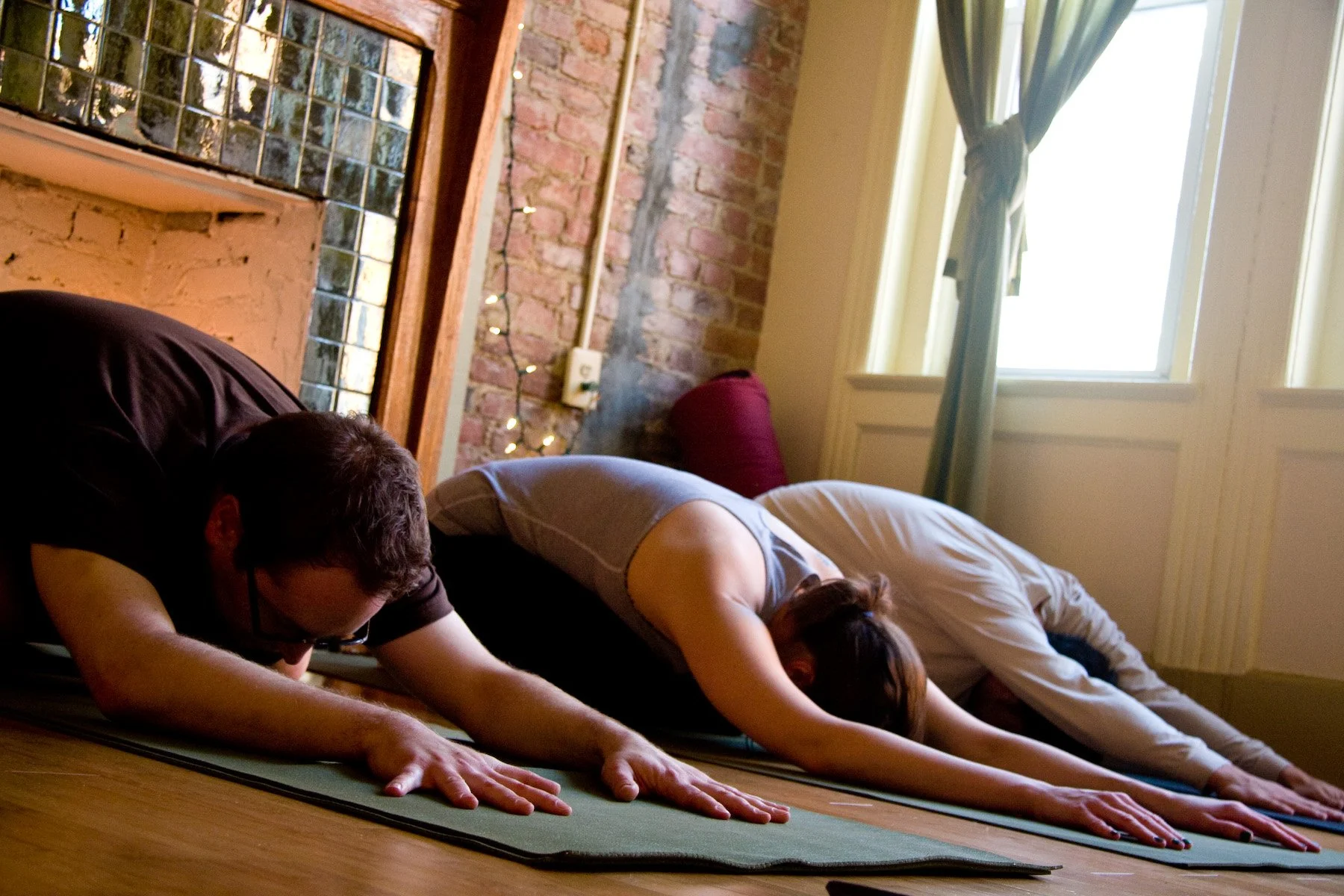
Yoga doesn’t erase these invisible weights, but it gives us a way to set them down for a while. On the mat, you practice more than movement—you practice allowing. Allowing the breath to soften the grip of your nervous system. Allowing your body to remember what it feels like not to brace, not to overfunction, not to hold everything alone. Through mindful movement, you begin to re-train your body to release instead of tighten.
A few times a week, even just for 45 minutes, yoga offers rehearsal space for a different way of being.
Your body learns safety in receiving support from the ground, the quiet work of rest and restoration.
Your nervous system practices downshifting from emergency mode into presence, building emotional resilience that carries into daily life. Your identity slowly expands beyond overfunctioning, beyond being “the capable one,” creating the foundation for sustainable well-being.
Neuroscientists often remind us that repetition rewires the brain. That’s why a consistent yoga practice matters. Each time you step on the mat, you’re not just stretching muscles—you’re training your brain and body to access calm more easily, even in moments of stress. Over time, softening becomes a skill rather than an accident.
And perhaps most importantly, you get to experience moments where you don’t have to carry it all. Where you can simply breathe, move, and belong. In practice, you’re reminded that strength isn’t only about pushing forward. It’s also about softening.
That’s the quiet gift of yoga. It helps us remember that resilience doesn’t come from holding tighter. It comes from letting go, even briefly, and trusting that the world won’t fall apart if we soften our grip.
Good Sleep: Yoga’s Role in Beating Insomnia
Just a couple of classes a week can help you fall asleep faster, stay asleep longer, and wake up more refreshed. Studies show yoga lowers cortisol (your stress hormone), calms the nervous system, and boosts melatonin production—the hormone that helps you drift off and stay asleep. We’ve seen it work for so many of our DC students, and it feels just as good as the research says it will.
practice yoga to help you sleep better
At Flow Yoga Center in Washington, DC, we’re here to help you sleep longer, fall asleep faster, and wake up feeling restored. ;)
Why So Many of Us in DC Are Tossing and Turning
If you’ve ever typed how to fall asleep faster or natural remedies for insomnia into your phone at 2 a.m., you’re not alone. The American Academy of Sleep Medicine says 30–35% of adults deal with insomnia symptoms each year, and the CDC reports more than 17% of us can’t seem to stay asleep most nights.
In a city like DC, it’s no surprise. Long days at the office, late-night events, and the fast pace of city life can leave your mind buzzing long after you’ve closed your laptop or stepped off the Metro.
The good news? A new study shows one of the most effective, natural solutions might be waiting for you right here at Flow.
The Study: Yoga Tops the Charts for Better Sleep
A 2025 systematic review in BMJ Evidence-Based Medicine looked at 22 randomized controlled trials and more than 1,300 participants with insomnia. Researchers compared 13 interventions, from therapy and lifestyle changes to seven types of exercise.
The results were clear: yoga and tai chi were the top performers.
Yoga increased total sleep time by up to two hours 💤
Tai Chi increased total sleep time by about 50 minutes
Walking and jogging helped reduce insomnia severity, but not as much as yoga
Dr. Jennifer Gourdin, a sports medicine physician with Kaiser Permanente in Silver Spring, MD, explained it simply:
“The two forms of exercise they mentioned that gave the most increased sleep time were yoga and tai chi. Both involve gentle movement with mindful breathing.”
Why Yoga Works (and Why We See It Every Day at Flow)
Here in our Logan Circle studios, we hear it all the time — “I’m finally sleeping better.” Just a few classes a week can make a big difference, and we’ve seen so many students go from tossing and turning to feeling completely restored. The best part? Science says it works.
Yoga can help with insomnia by:
Lowering stress hormones like cortisol
Activating your parasympathetic nervous system (your “rest and digest” mode)
Loosening tension that makes it hard to get comfortable in bed
Training your mind to shift away from racing thoughts
Unlike high-intensity workouts, yoga offers gentle, restorative options that prepare you for deep, long-lasting rest.
Our Favorite Sleep-Friendly Classes in DC
If you want to see what the research is talking about, try these Flow classes designed to help you sleep better:
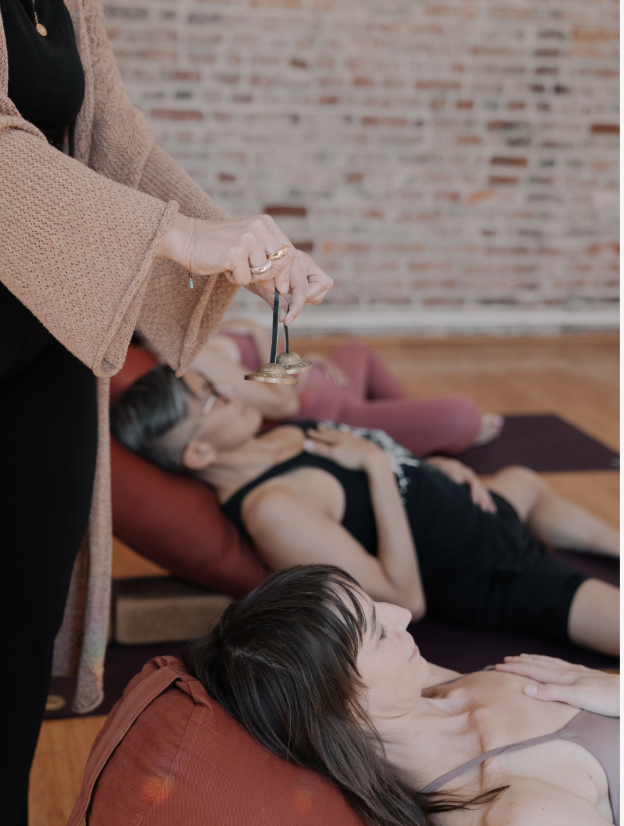
Restorative/Yin Yoga with Crystal Bowl Sound Bath – Deep relaxation that melts away tension.
Feel-Good Vinyasa – Smooth, steady movement to reset your body and mind.
Slow Flow & Meditation – Gentle poses and mindfulness for a calm, grounded evening.
Each class is beginner-friendly and led by our amazing instructors who know how to help you let go of the day and prepare for deep rest.
When you sleep well, everything in your day feels better. Flow Yoga Center can help you get there. Whether you are brand-new to yoga or already an experienced practitioner, we’ll help you create a practice that supports better sleep, more energy, and a calmer mind.
📅 Check our schedule and book your first class today: flowyogacenter.com/schedule

When Emotions Feel Like Too Much: Try This 4-Step “RAIN” Practice
There are days when you can feel it building—just beneath the surface.
The tight chest. The lump in your throat. The low hum of anxiety or the sharp flicker of anger.
And sometimes, it catches you off guard: everything feels fine until it doesn’t.
That moment—when you feel the spin or the heaviness—isn’t a personal failure.
It’s a signal. An invitation to slow down, turn inward, and meet yourself gently.
There’s a practice we love for moments like this. It’s simple. It’s portable. And it helps you move from overwhelm into grounded presence. It’s called RAIN.

There are days when you can feel it building—just beneath the surface.
The tight chest. The lump in your throat. The low hum of anxiety or the sharp flicker of anger.
And sometimes, it catches you off guard: everything feels fine until it doesn’t.
That moment—when you feel the spin or the heaviness—isn’t a personal failure.
It’s a signal. An invitation to slow down, turn inward, and meet yourself gently.
There’s a practice we love for moments like this. It’s simple. It’s portable. And it helps you move from overwhelm into grounded presence. It’s called RAIN.
R – Recognize
Start by simply noticing what’s here. Not with judgment, just awareness. A swirl of emotion. A racing heart. A tight jaw. A voice in your head that says, “This is too much.”
Recognizing doesn’t mean analyzing. It just means gently naming what you’re experiencing:
“I’m feeling overwhelmed.”
“There’s tension here.”
“Something feels tender.”
This is the first moment of stepping out of autopilot and into presence.
A – Allow
Instead of pushing the feeling away or trying to fix it, soften. Allow the emotion, the discomfort, the story—just as it is.
This might sound like:
“I don’t have to like this, but I’m willing to feel it.”
“This is what’s here right now.”
Allowing gives your nervous system permission to stop fighting itself. You’re letting go of the need to perform calmness or power through. You’re just being with what is.
I – Investigate
Now, turn toward yourself with gentle curiosity.
Where do you feel this in your body?
What might this part of you need?
What’s underneath the emotion—fatigue, fear, unmet needs?
There’s no need to force insight. This isn’t about solving. It’s about listening.
This is where the wall between emotion and awareness begins to soften.
N – Nurture
This is the part we often skip—but it’s the most important. Offer yourself kindness. Not as a performance, but as a true gesture of care. You can place your hand on your heart or speak words of support inwardly:
“It’s okay to feel this.”
“I’m with you.”
“You’re doing your best.”
You don’t need to have it all figured out to be worthy of compassion. You already are.
Why This Practice Matters
RAIN doesn’t remove what you’re feeling—it helps you relate to it differently.
It brings you back into relationship with yourself. It creates space, softness, and often, just enough relief to take the next step with more steadiness.
This is how we build resilience. Not by avoiding, but by learning to stay—lovingly, curiously, and without self-judgment.
So the next time a wave rises, try this:
Pause.
Feel.
Soften.
Care.
And remember: you don’t have to go through hard moments alone or armored.
There’s a path back to yourself.
One breath, one pause, one kind word at a time.